





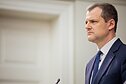






Lithuania’s foreign minister said emerging discussions about the country’s policy toward Belarus do not mean it is being reconsidered or will be reviewed immediately.
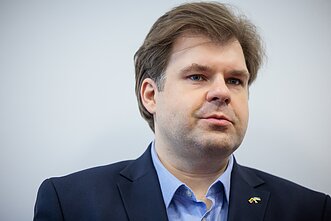
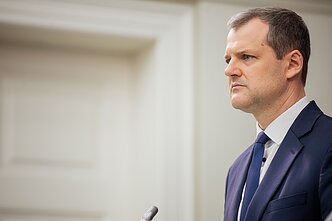
“It seems to me that what is being misinterpreted is that if we discuss something, it means that we are questioning the current policy and therefore assume it will be reviewed immediately. No, we need to check whether what we are doing is really good,” Foreign Minister Kęstutis Budrys said in an interview published Wednesday on lrytas.lt.
His comments come as members of Lithuania’s ruling coalition have increasingly mentioned the possibility of resuming dialogue with Minsk.
Mindaugas Sinkevičius, leader of the ruling Social Democratic Party, has said a meeting at the deputy minister level should not be considered taboo and stressed that Lithuania must respond to the actions of its partners in the European Union and the United States.
At the same time, Sinkevičius said a return to broader political dialogue with Minsk would only be possible after the EU extends its sanctions against Belarus.
Budrys voiced support for ongoing discussions about sanctions policy, saying he has “a bunch of arguments” why sanctions remain one of the most effective economic and political tools.
“If someone thinks that sanctions do not work, let’s discuss whether the chosen area is wrong or whether, for example, enforcement is not working, because that is also part of the problem,” he said. “Circumventing sanctions is a big issue, as our whole situation with haulers has shown. We probably have more than one grey area here.”
The minister said discussions about the results and benefits of sanctions are legitimate, but argued it cannot be claimed they have failed until all available measures have been exhausted.
“As long as we have not exhausted all resources in our sanctions policy toward both Russia and Belarus in order to change their behaviour, I disagree that sanctions are an ineffective measure in this situation, because we have not yet been convinced,” Budrys said.
“We must implement the sanctions package in full. America has reserves and Europe has reserves. And we still have more to do. So there are no changes in policy or stance at this point,” he added.
Budrys said that Lithuania’s position on the reasons for imposing sanctions on Belarus has not changed and said there is no basis for lifting them.
“The sanctions were imposed because of human rights violations, because Minsk is aiding aggression against Ukraine, because it is aiding Russia in committing war crimes, including the abduction and indoctrination of children,” he said. “Until that changes, there is no reason to talk about changing the sanctions or any kind of easing. On the contrary, Lithuania has expanded its sanctions regime against Belarus.”
In mid-December US President Donald Trump’s envoy, John Coale, reached an agreement with the government of President Alexander Lukashenko on the release of some political prisoners and the lifting of sanctions on Belarusian potash fertilisers.
The development prompted speculation among political observers that Washington could pressure the EU and Lithuania to allow the transit of Belarusian fertilisers through the port of Klaipėda again.
Products from Belarusian potash giant Belaruskali were transported through Lithuania and the port of Klaipėda until February 2022, when Lithuania halted shipments, citing US sanctions and national security concerns.
Belaruskali filed a claim with an arbitration court in December, seeking $12.09 billion in damages from Lithuania.
The EU later imposed its own sanctions on Belarusian fertilisers and is expected to decide later this month whether to extend them.